
Think

Consider the following questions:
- Have you ever gone duck or goose hunting?
- Do you know anyone who has gone duck or goose hunting?
- What kind of environment do waterfowl, like geese and ducks, prefer to live in?
Goose hunting is a traditional activity for many Cree people living in the Hudson and James Bay region. Thousands of waterfowl, including geese and ducks, gather at the southern tip of James Bay during migration. The Hudson and James Bay Lowlands Wetland is a large area of marsh and swamp, the perfect environment for geese.
Are you wondering why we are starting off the course talking about geese and marshes in the Hudson and James Bay Lowlands? Well, it is because this is an environmental science course and the biodiversity of the Hudson and James Bay Lowlands has a great deal to teach us about risks to fragile habitats all around the world.
Join the discussion

Examine the following images of the James Bay Lowlands Wetland and consider what features make this an attractive place for waterfowl, like ducks and geese. In a discussion board post, share at least three features and explain your ideas with reference to the images. You can share your ideas in written, audio, video, or other visual formats.
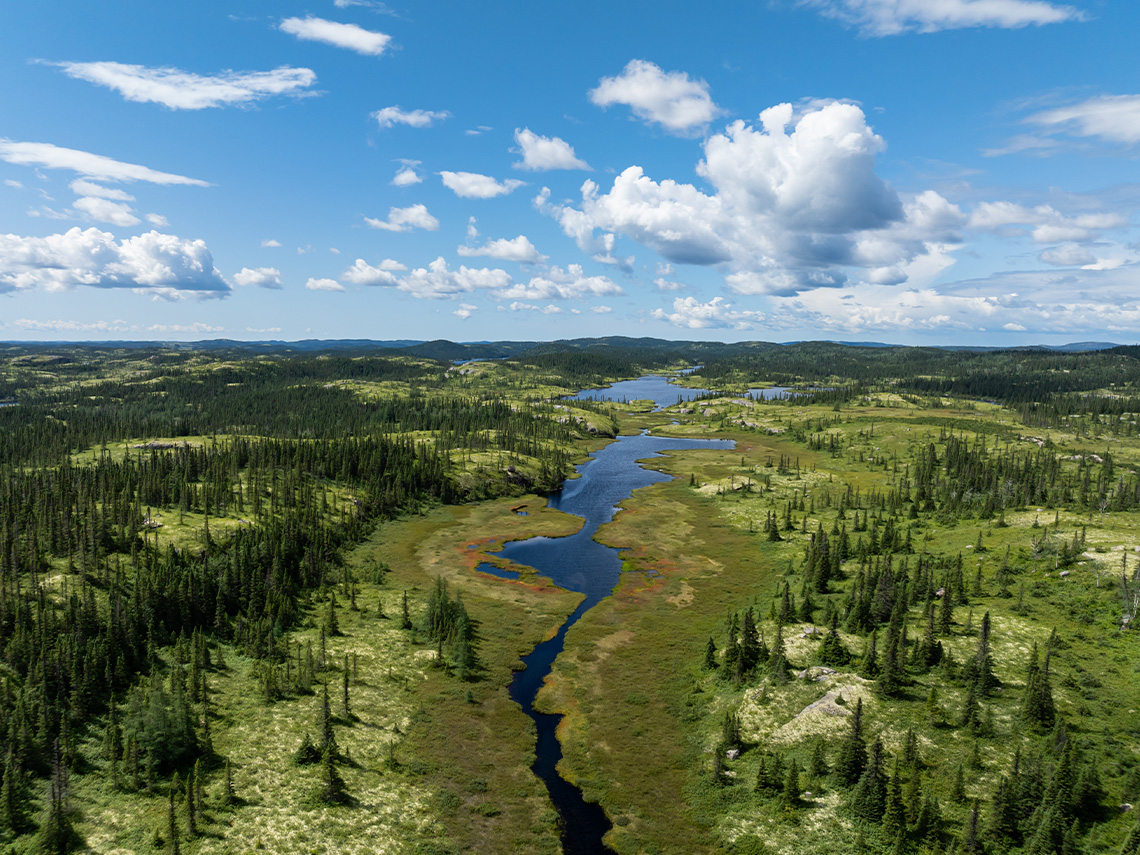
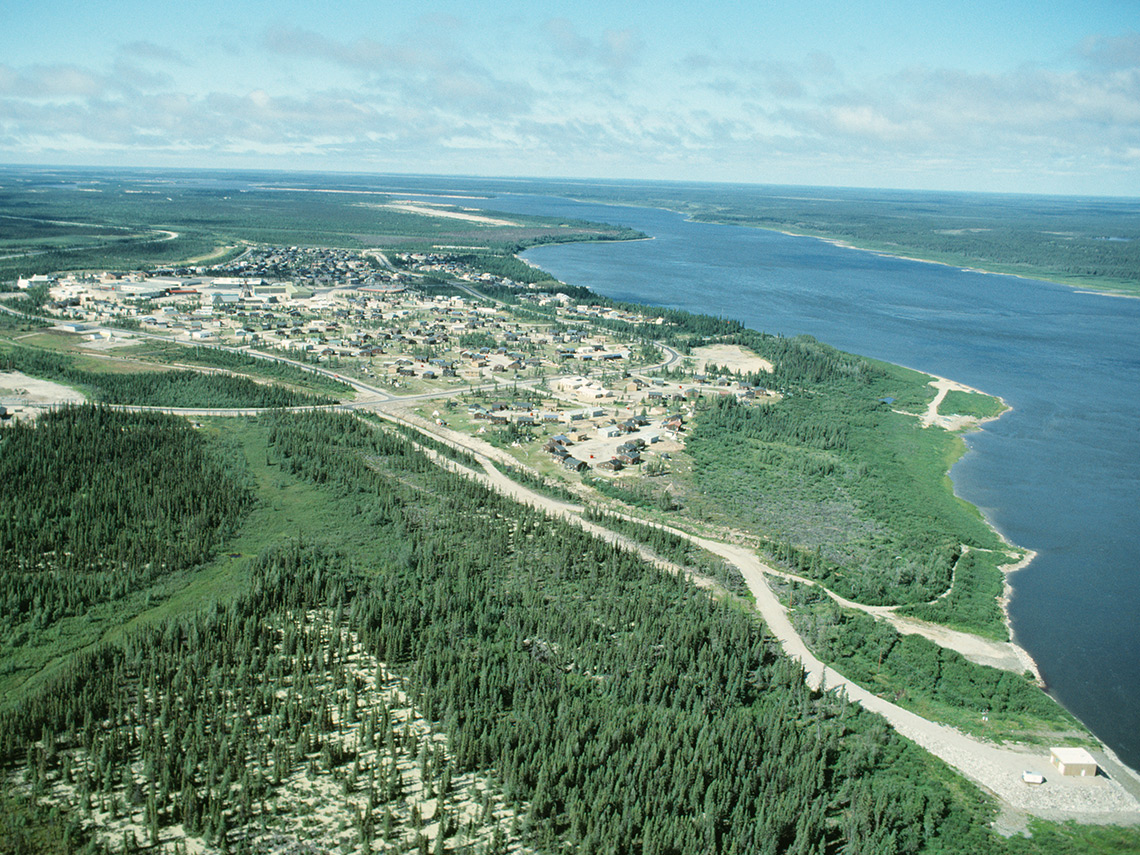
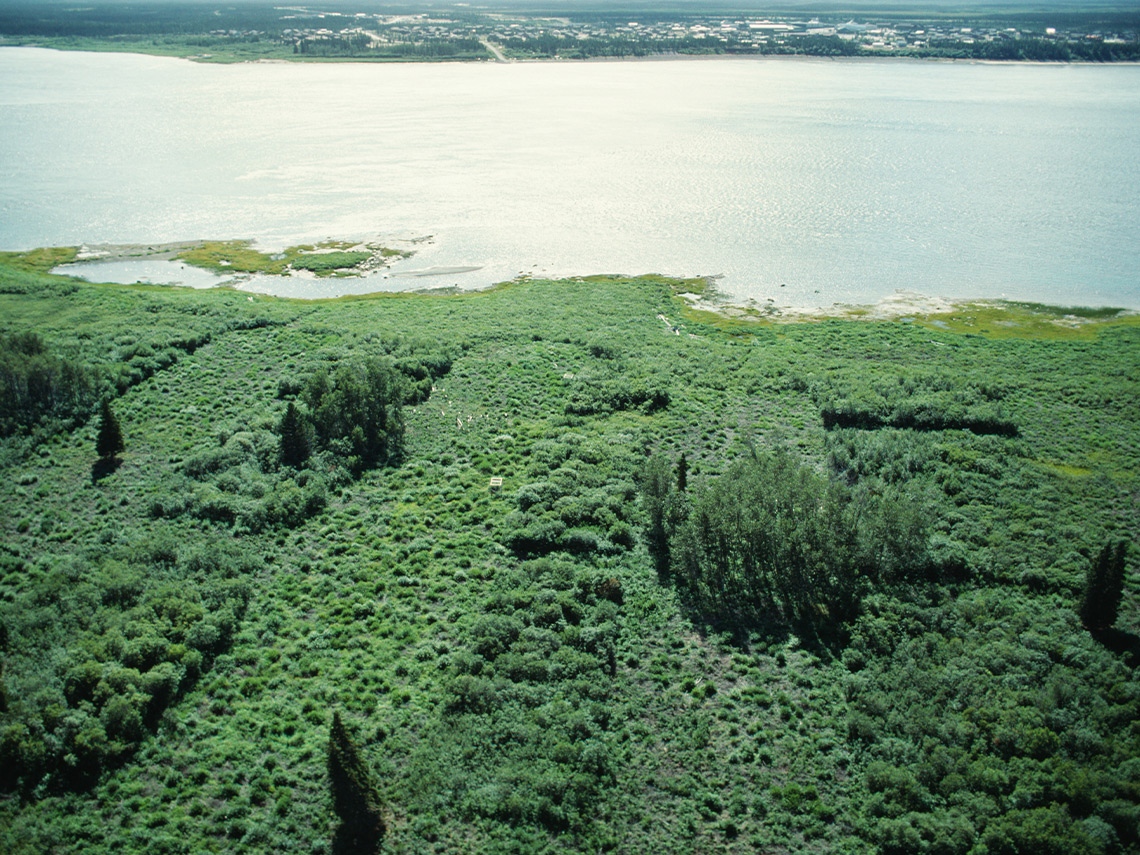
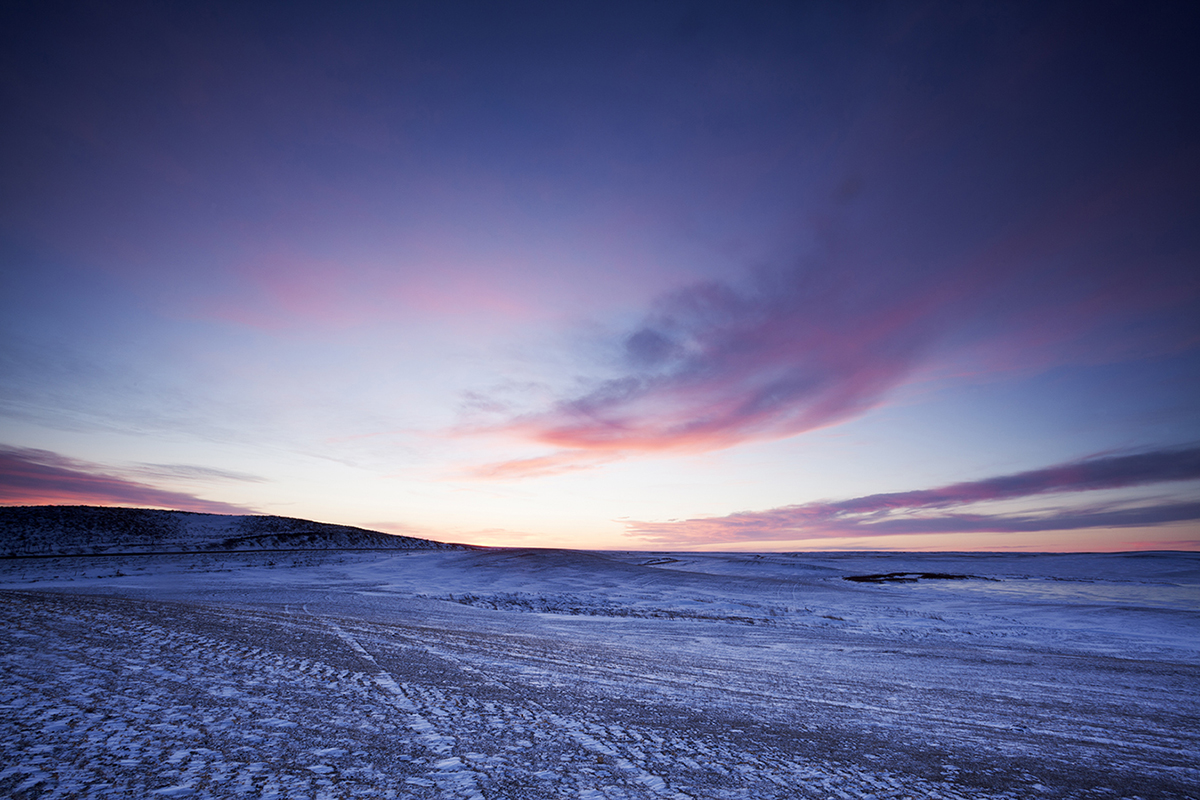
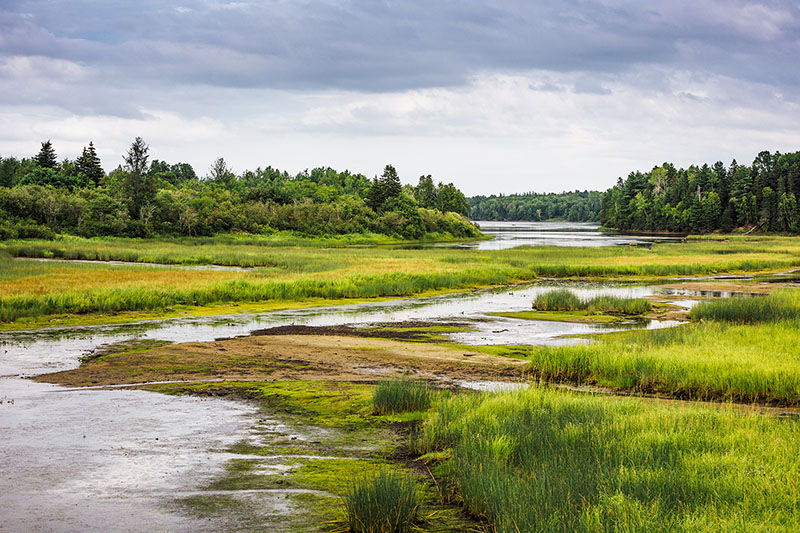
In this learning activity, you will focus on different aspects of biodiversity, including the effect of human activity on different ecosystems.
Transferable skills

One of the skills we are practicing in this learning activity is “Critical Thinking and Problem Solving.” You will be engaging in inquiry processes (locating, processing, interpreting, synthesizing, and critically analyzing information) in order to solve problems and make informed decisions.

Wetlands as ecosystems
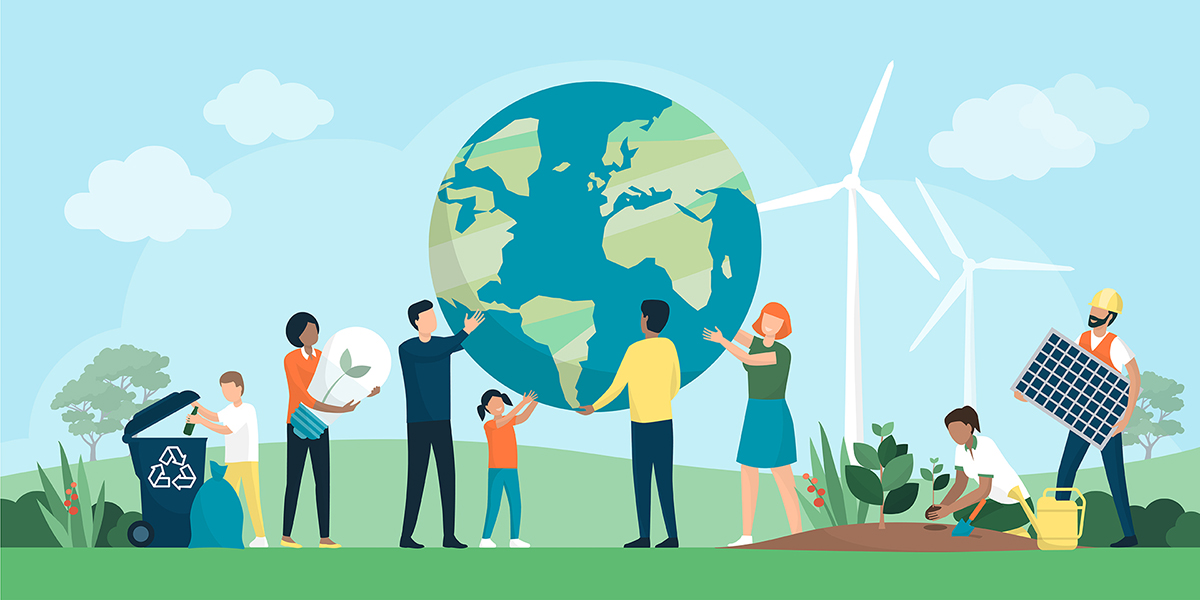
Wetlands are areas where the land is saturated by water for all or part of the year. They are places where soil and water meet. A wide variety of grasses, plants, birds, insects, and animals live in wetlands. They are home to many different species and are considered the most diverse type of ecosystem.
An ecosystem is an area where all living (biotic) and non-living (abiotic) things interact together in a network. Biotic elements include humans, plants, animals, and insects. Abiotic elements are things like rocks, minerals, sun, soil, and water.
Try it!

Examine the following illustration of the Hudson and James Bay Lowlands Wetland and try to identify the biotic and abiotic elements pictured. Use your notebook so you can reflect on how you understand these concepts throughout this Unit.
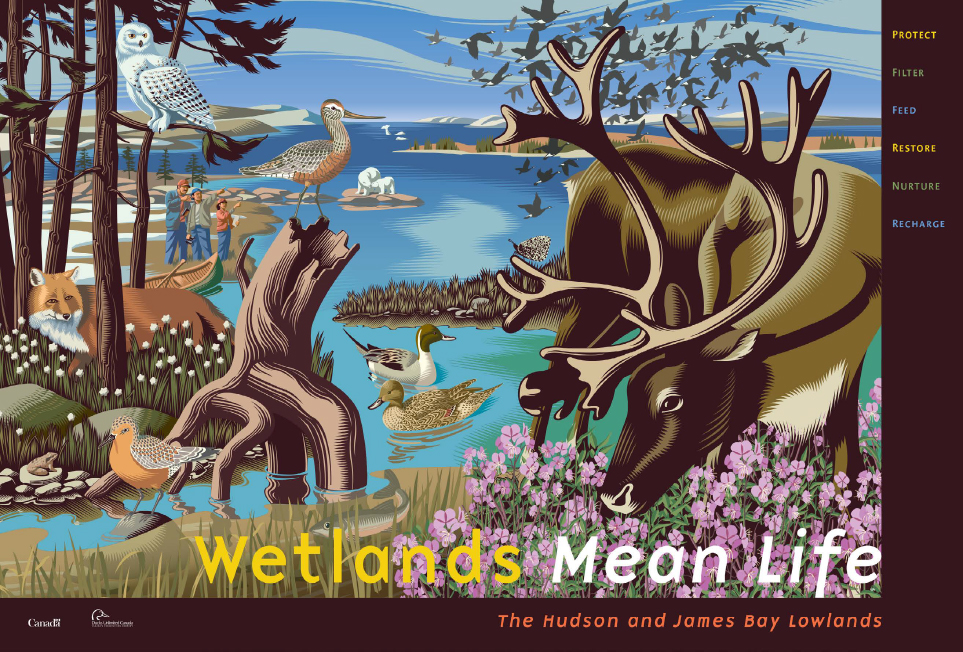
- What are some biotic (living) elements in the Hudson and James Bay Lowlands ecosystem?
- What are some abiotic (non-living) elements in the Hudson and James Bay Lowlands ecosystem?
All things in an ecosystem depend on each other. For example, many animals depend on other animals for food, and plants depend on the sun and earth for energy and nutrients.
Biodiversity
The more diverse an ecosystem, the more different types of animals, plants, and micro-organisms it has. Biodiversity is a measure of how many different types of living things are in an ecosystem. Higher levels of biodiversity lead to healthier ecosystems.
Biodiversity allows an ecosystem to survive threats such as bad weather, disease, or human activity. For example, a bird living in an area of great diversity may eat 30 different types of insects in addition to earthworms. In an ecosystem with very little biodiversity, there may be only five different types of insects to eat. If something were to impact the earthworm population, a bird that has 30 types of insects to eat would likely find plenty to feed on. On the other hand, a bird that has only five types of insects to eat could very well starve. Greater biodiversity allows ecosystems to bounce back and remain healthy in situations where part of the network is damaged.
Biodiversity is also important to humans, not only for the enjoyment of a variety of healthy ecosystems, but also because humans depend on a wide variety of plant, animal, and insect species. Consider corn as an example. There are many different types of corn. Each species of corn has a unique set of properties, including the following:
- growing time,
- colour,
- taste, and
- ideal environment.
These properties allow different types of corn to be grown in different environments all over the world.
Think
Take a moment to think about why biodiversity is important to humans. Imagine there were just a few species of fruits and vegetables that people could eat. What would happen if there was a terrible drought that lasted several years? How would the biodiversity of the fruits and vegetables be impacted? How would humans be impacted?
Now, explore the following message from the Assembly of First Nations about honouring Earth and consider once again why biodiversity is important to humans.
“From the realms of the human world, the sky dwellers, the water beings, forest creatures and all other forms of life, the beautiful Mother Earth gives birth to, nurtures and sustains all life. Mother Earth provides us with our food and clean water sources. She bestows us with materials for our homes, clothes and tools. She provides all life with raw materials for our industry, ingenuity and progress. She is the basis of who we are as “real human beings” that include our languages, our cultures, our knowledge and wisdom to know how to conduct ourselves in a good way. If we listen from the place of connection to the Spirit That Lives in All Things, Mother Earth teaches what we need to know to take care of her and all her children. All are provided by our mother, the Earth.
Indigenous peoples are caretakers of Mother Earth and realize and respect her gifts of water, air and fire. First Nations peoples’ have a special relationship with the earth and all living things in it. This relationship is based on a profound spiritual connection to Mother Earth that guided Indigenous peoples to practice reverence, humility and reciprocity. It is also based on the subsistence needs and values extending back thousands of years. Hunting, gathering, and fishing to secure food includes harvesting food for self, family, the elderly, widows, the community, and for ceremonial purposes. Everything is taken and used with the understanding that we take only what we need, and we must use great care and be aware of how we take and how much of it so that future generations will not be put in peril.
Environmental degradation affects the health and well-being of not only the First Nations people but all peoples of North America and the world in many ways. First Nations peoples do not yet know all the ways harmful human-made substances affects fish, wildlife, habitat, and human beings. However, First Nations people are aware that pollutants and contaminants, especially those originating from industrial development, have negative consequences for the health of all living things, including humans. Industrial contamination and disruption of wildlife habitat combine to reduce the supply and purity of traditional foods and herbal medicines. Finally, degradation erodes the quality of life dependent on the purity of the land, water, flora and fauna, and further affects Indigenous people’s cultures, languages and spiritual health and well-being.
First Nations peoples can demonstrate how, in asserting their land use and rights, economic initiatives can be both profitable and sustainable for future generations. First Nation traditional knowledge has provided our people with the tools to care for Mother Earth and our sacred sites. This knowledge can be shared with industry for the betterment and survival of all peoples. ”
After exploring the message, did your thoughts about biodiversity change? As we proceed through this course, continue to consider the beliefs outlined in the Assembly of First Nation’s message.
Hudson and James Bay Lowlands Wetland
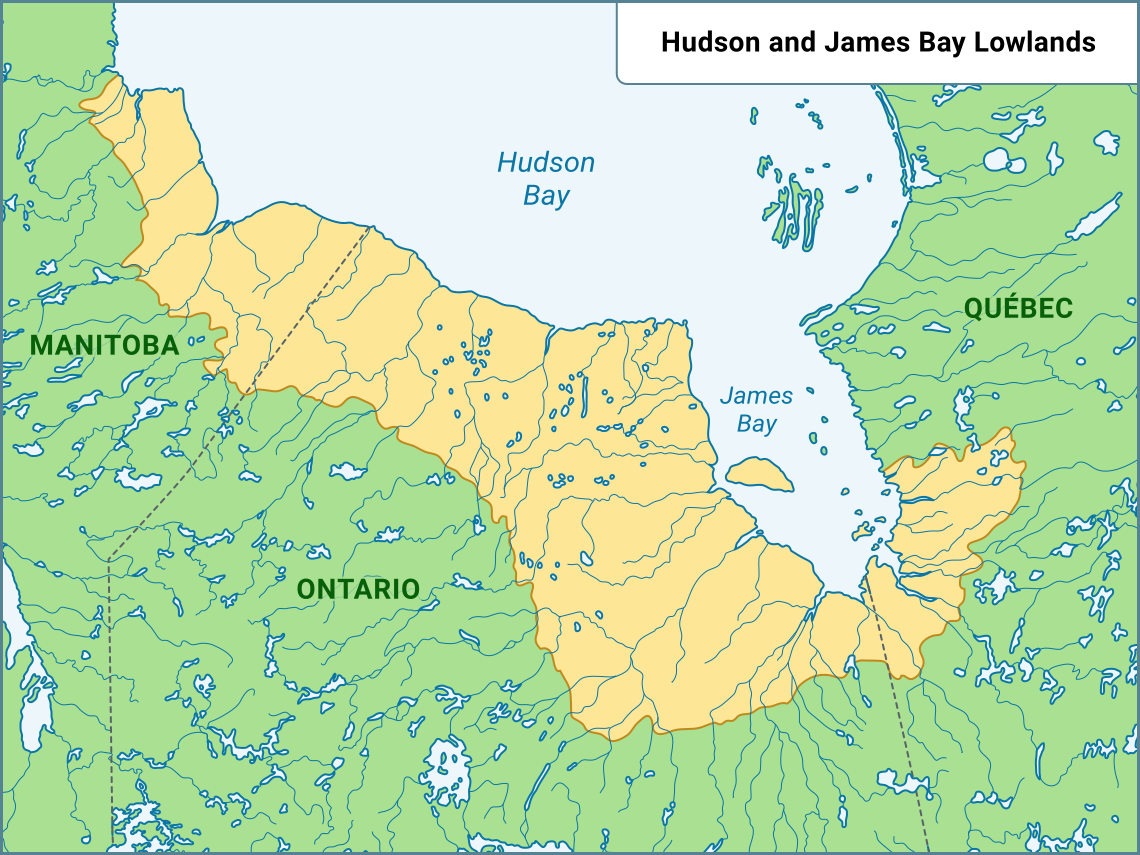
The following map indicates the Hudson and James Bay Lowlands Wetland in yellow. This wetland is located in northern Ontario (about as far north as you can go in Ontario) along the coasts of the James and Hudson Bays.
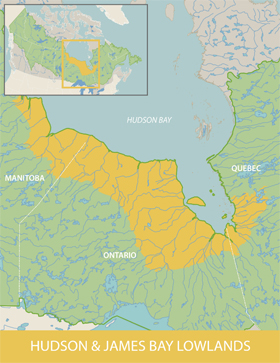
Source: borealbirds.org/blog/wetland-wonders-hudson-james-bay-lowlands
This wetland is a large area of marsh and swamp with a high level of biodiversity. Within this diverse ecosystem are three internationally recognized and protected sites with wild populations of whales, caribou, geese, ducks, and polar bears. These animals depend on each other in a network that’s similar to an interconnected web.
Using food webs to illustrate biodiversity
The connections between things in an ecosystem, and how each species depends on another to survive, are often illustrated using what’s called a food web. Learn more by exploring the document titled "Wetlands mean life" (Opens in new window), which describes the food web in the Hudson Bay and James Bay Lowlands.
Let’s further examine the following diagram of the wetland food web.
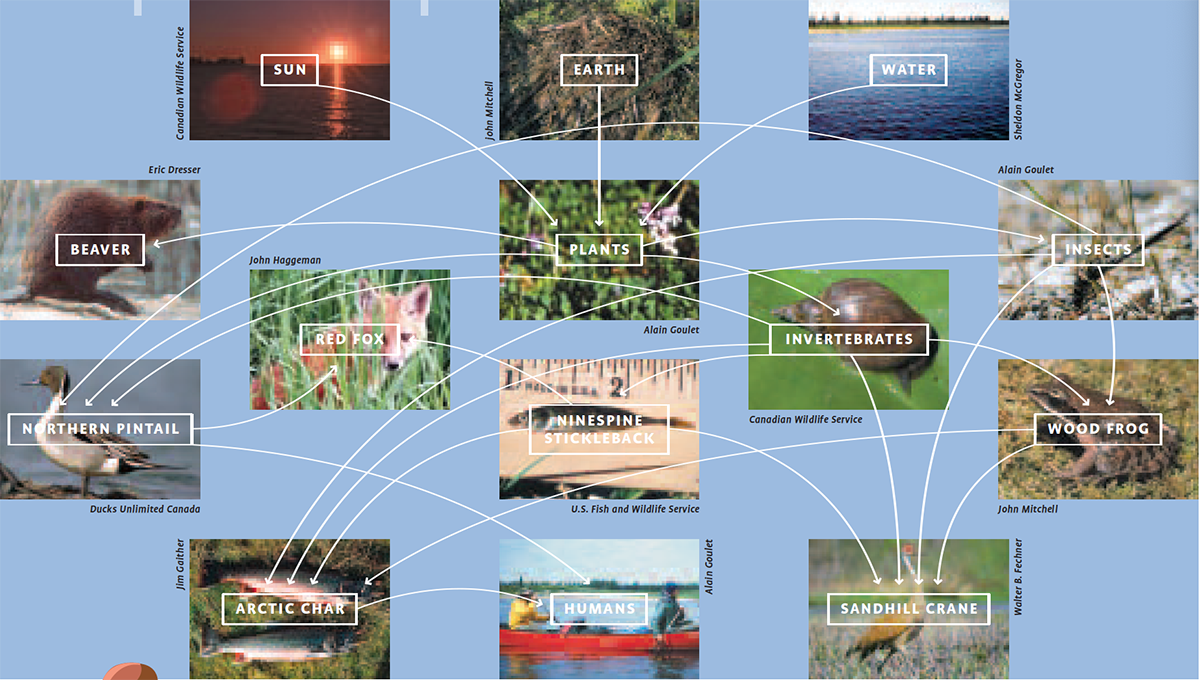
This food web shows how plants in the Hudson and James Bay Lowlands ecosystem rely on the earth, the sun, and water to grow. These are not all the living things in this area, just a sample. If you follow the arrows away from the plant, you’ll notice that animals, insects, and birds all rely on plants for their food. In turn, these animals, insects, and birds are eaten by other species.
Join the discussion
Let’s consider how a change in one wetland species can have a ripple effect on the entire ecosystem. In a discussion board post, explain what you think would happen and why in the following situations:
- Situation 1: Imagine something contaminated the water in this region and that the contaminant hurt or damaged the ninespine stickleback population.
- Situation 2: Arctic char is a fish that many humans love to eat. Imagine that there is overfishing in the ecosystem causing the Arctic char population to decrease.
As demonstrated from these examples, when one part of the ecosystem is affected or severely damaged, it completely changes the course of the entire ecosystem because everything is interconnected and interdependent.
Do you know of any other protected wetlands in Ontario, whether in rural or urban cities? A good example of this is the Cootes Paradise area in Hamilton, Ontario. It’s a protected wetland area along the shores of Hamilton Harbour in Lake Ontario where waterfowl and fish breed and feed. Urban wetland areas like this are perfect examples of where there are patches of biodiversity in cities with very little other wildlife.
Carrying capacity
You may have encountered news reports about the problem of overpopulation in the world. This means that the human population has grown beyond its carrying capacity.
Definition

A population’s carrying capacity is the number of individuals the environment can sustain with food, water, and living space.
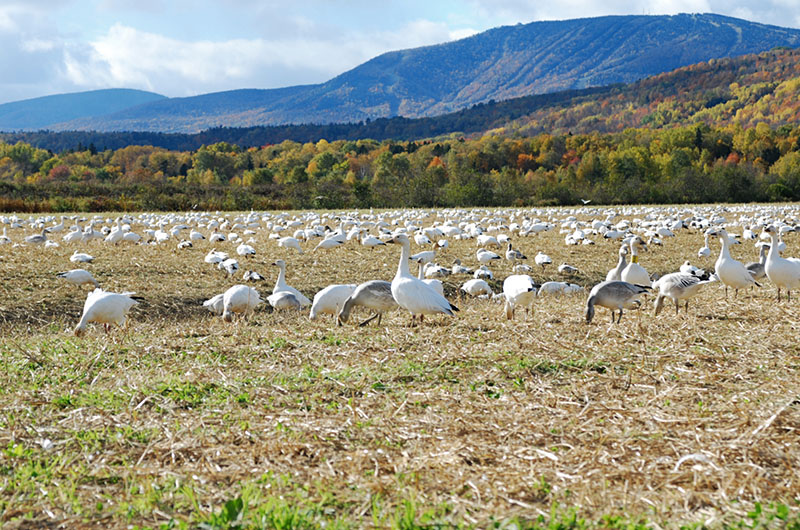
The lesser snow goose is an example of a species reaching its carrying capacity. An incredible four million lesser snow geese now gather in the marshes of the Hudson and James Bay Lowlands every spring and autumn.
The geese spend their winters in the south, where waste grain is left on farmers’ fields after the harvest. Farmers sometimes even flood the fields to attract waterfowl because their presence improves soil quality. Their feces and waste provide good fertilizer, and the water prevents soil from eroding or blowing away. The geese can easily eat this waste grain without any work and end up growing very strong and have successful breeding rates. This has resulted in a huge increase in their population.
When the geese migrate north to the tundra (areas without farms), they rely on plant life for food. With a population so big, they damage fragile northern ecosystems by eating a large amount of plants. This makes it difficult for other species to live there and affects the food web in many ways. It also means that the lesser snow goose has reached the carrying capacity of the tundra. The population is at a level where no more can be supported without running out of food in the summer.
Try it!
Check your understanding of some of the new terms and concepts introduced in this learning activity by completing the following tasks.
Part 1 - Fill in the blanks in the following sentence. Choose the best option for each blank.
A [ _________1]’s carrying capacity is the [ _________2] of individuals that can be [ _________3] by the environment with [ _________4], [ _________5], and [ _________6].
Part 2 - Imagine one of the predator populations in the Hudson and James Bay Lowlands is reduced and the Arctic char population grows beyond its carrying capacity. How will other populations in the ecosystem be affected? Consider the following image.
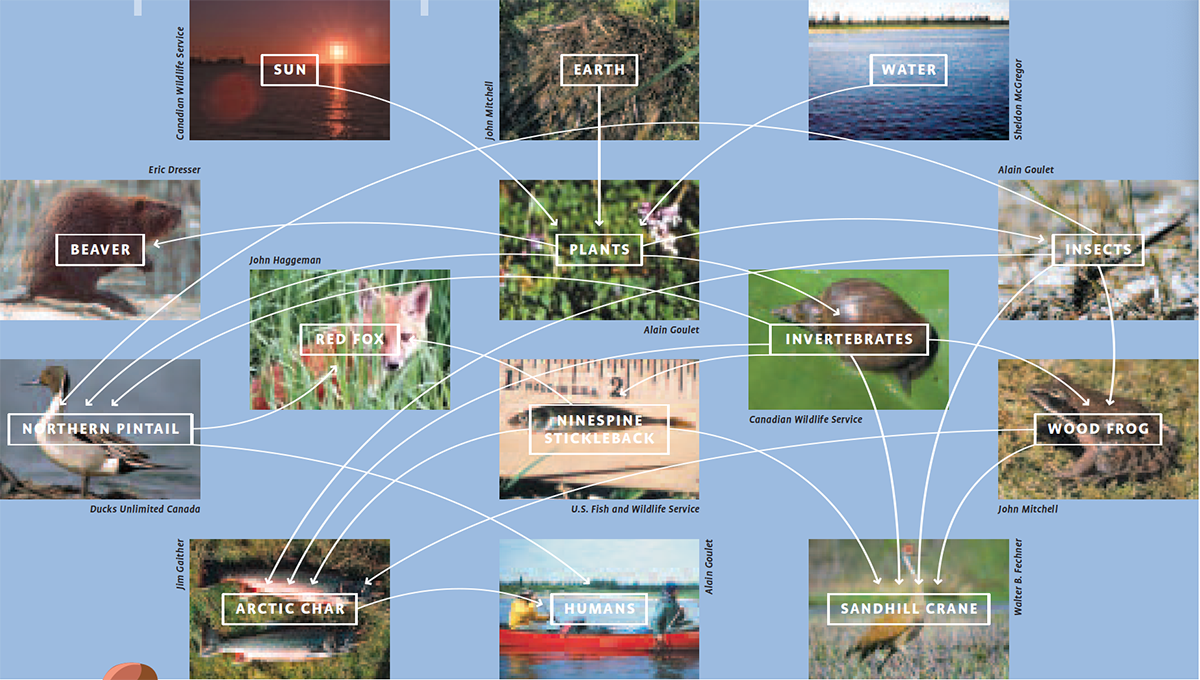
Please refer to the image you just examined for the next set of multiple choice questions.
Threats to biodiversity
There are many factors that threaten biodiversity which cause species to die off or become extinct. Many of these threats have been caused by an ever-growing human population and its impact on the natural world.
Humans have affected almost every natural thing in the environment, which in turn has reduced biodiversity. People have polluted water, air, and soil around the globe. Efforts have often focused on progress, development, and technologies at the cost of the environment. Although attitudes toward the environment have begun to change, many of the problems created in the past remain in today’s society.
Notebook

Let’s explore four of the major threats to biodiversity. Use the following tabs below to explore one of the threats and complete the graphic organizer in your guided note taking document (Opens in new window). You can refer to the section "Challenges to sustainability" in "Wetlands mean life" (Opens in new window) to give you more information about the threats to biodiversity in the James Bay Lowlands Wetland. Be ready to share your ideas with your class.
Sustainable versus renewable resources
Each of the four major threats discussed before can decrease biodiversity, and in turn harms ecosystems. The impact on the environment is both damaging and disturbing. What can be done to reduce these threats?
One thing you can do to maintain the health of ecosystems is to use sustainable resources. A resource is sustainable if using it doesn’t hurt the environment and it doesn’t deplete the natural environment and its sources. For example, using windmills to generate power is considered sustainable because wind cannot be depleted since it is a natural occurrence. At the same time, it’s important to consider that everything you do affects the environment and can have positive or negative impacts. Windmills provide a sustainable source of power; however, birds sometimes fly too close to windmills, get trapped, and are injured or killed by the spinning components.
Discover more

Are you familiar with “ocean-friendly” or “sustainable” seafood? If not, please do your own internet search using the terms “ocean-friendly” and “sustainable” for resources that explain how fisheries incorporate sustainable practices and how to shop for sustainable seafood.
Another way to preserve the health of ecosystems is to use renewable resources. A resource is renewable if it can be used again. For example, if you harvest trees (log) properly by replanting, there will be new tree growth that can be harvested again in approximately 30 years. Many industries are using cork trees and bamboo plants instead of hardwood trees because they grow back in 5 to 10 years instead of 30. These plants are used to make cork flooring, bamboo flooring, bamboo furniture, and even bamboo fabric.
Using sustainable and renewable resources helps preserve the health of ecosystems by reducing negative impact by humans on biodiversity.
Many industries can have a negative impact on the environment. As you’ll discover in the next section, one of them is travel and tourism.
Ecotourism
In 2018, according to Statistics Canada, the Canadian tourism industry generated more than $80 billion in revenue.
Join the discussion
Can you imagine the impact that an abundance of tourism could have on the environment? Consider the following tourism activities and discuss the possible negative impacts on the environment for each.
- People use various modes of transportation to travel globally.
- Resorts and hotels are often built in prime environmental locations.
- Harsh chemicals are used to clean washrooms, floors, and bedsheets in hotels.
Ecotourism is a new trend in tourism that focuses on respecting both the environment and the local culture. Using methods of travel that have a minimal impact on the environment, tourists go to natural areas and appreciate the local culture.
Costa Rica is one country where ecotourism is thriving. Environmentally friendly resorts and guides offer insight into local culture as well as low-impact activities such as exploring the bird population, kayaking, biking, horseback riding, and zip-lining. All these activities are great ways to appreciate nature.
Sometimes ecotourism actually involves volunteering to help with ecosystem restoration or supporting species at risk. Consider the following video describing a form of ecotourism involving volunteer work.
Explore this!

Explore the following video titled "Ecotourism in Costa Rica."
Costa Rica is a small developing country with a wide variety of ecosystems, including beaches, rainforest, and volcanoes. All these ecosystems have plenty of biodiversity and wildlife. Costa Rica has invested in developing ecotourism as a major industry. From an environmental point of view, though, ecotourism can have both positive and negative impacts.
On the negative side, any tourism brings with it increased emissions from planes and vehicles. Added to this substantial source of pollution are other impacts on the environment, such as increased travelling in natural areas and the production of waste. Waste comes in the form of human waste (feces, urine), food waste, packaging from the products consumed, and chemical waste from cleaning processes.
Ecotourism can be regarded as positive because it brings in enough income that natural land doesn’t have to be sacrificed to industries that might build large factories or other developments. At the same time, ecotourism encourages small-scale, environmentally friendly building in areas developed for tourism. Unlike the large hotels and buildings of traditional tourism, these small establishments allow tourists to experience local culture. Ecotourism also encourages small conservation initiatives such as fundraising to support rainforest conservation. When tourists return from their eco-vacations, many decide to help the environment they visited either by returning to support current conservation programs in the country or to start new initiatives with funds they’ve raised.
Costa Rica has done a good job of regulating its ecotourism industry and balancing the need for income (money) with the need for ecosystem health. It’s a delicate balancing act to enforce all the environmental laws and still generate profit.
To further your understanding about the impact of ecotourism on Costa Rica, explore this article entitled "Ecotourism Costa Rica" (Opens in new window) that describes the impact on the guides who work in the industry.
Many countries and organizations struggle with the same balancing act. It’s always important to consider the environmental impact of activities you choose to participate in.
Evaluating leisure and tourism activities
Bear hunting, a sport in Northern Ontario for some, a way of life for others, is another example of the balancing act between economics and ecosystem damage. In Ontario, the Ministry of Natural Resources (MNR) regulates hunting and fishing. For years, bear hunting was allowed twice a year, once in the fall and once in the spring. In 1999, MNR ended the spring bear hunt.
To analyze the impact of bear hunting, we must consider both negative and positive impacts on the environment, as well as how bear hunting can become more environmentally friendly.
Notebook
Complete the graphic organizer in your guided note taking document (Opens in new window) by listing some possible positive and negative impacts of bear hunting, and some ideas about how to make the tourism activity more environmentally friendly. Take into consideration what we learned about biodiversity and the balance of elements in ecosystems.
As demonstrated by the examples in Costa Rica and Northern Ontario, even recreational activities that seem to have a negative impact on the environment can have some positive effects. The bottom line is that it’s important to evaluate the impact of leisure and tourism activities, and to make those activities as environmentally friendly as possible.

Task: Assessing impacts of tourism
Within Ontario, there are numerous summer activities that people engage in throughout the summer months. Some activities include spending time outdoors playing sports, attenting recreational centres, fishing, or spending time at cottages or resorts. Among the most popular activities on Ontario’s lakes are waterskiing and wakeboarding, which are various forms of tubing activities.
Wakeboarding is like snowboarding on water. Participants ride a board behind a motorboat, jumping and doing tricks off the boat’s wake. The sport is becoming so popular that communities are competing to host Wakestock, an annual wakeboarding competition. It attracts many fans and tourists, so communities want to host the festival to make money.
Join the discussion
Discuss at least three negative impacts of tubing in either (winter or summer). Then, comment on a classmate’s post to suggest a way to make this tourism activity more environmentally friendly. Note that there are no environmental benefits associated with tubing. You can share your ideas in written, audio, video, or visual format.
Review

Key concepts
Review the key concepts from this learning activity. Take a brief break and then press the following tabs to review any concepts that you have not fully understood.
This is an area where all living (biotic) and non-living (abiotic) things interact together in a network.
This is a measure of how many different types of living things are in an ecosystem.
This refers to the number of individuals in a population that the environment can sustain with food, water, and living space.
This is the harm done to an ecosystem as a result of humans introducing contaminants into the natural environment.
This refers to the displacement of living things caused by humans spreading into the natural environment.
This refers to the change in weather patterns that occurs over a long period of time.
This is a type of plant, animal, or insect that is moved from its native ecosystem into a new ecosystem, throwing off the existing balance.
These are resources that don’t hurt the environment and don’t get used up.
These are resources that can be used again.
This is a new trend in tourism that focuses on respecting both the environment and the local culture.
Connecting to transferable skills
Recently, Ontario worked with other provinces in Canada to outline a set of competencies that are requirements to thrive. Ontario then developed its transferable skills framework as a set of skills for students to develop over time. These competencies are ones that are important to have in order to be successful in today’s world.
Read through the framework and the student look-fors (Opens in new window). Copy this document into your notes - you'll refer to it in each unit.
Note the indicators that you think you will develop in this course. At the end of the course you will revisit these skills to see which ones you actually developed and if your original predictions were correct.
As you continue through this unit and the rest of the course, keep your notebook updated and be mindful of opportunities to apply and develop transferable skills.