
Introduction
This learning activity examines the life cycle of stars and how that cycle depends on the initial mass of the star. You will become familiar with a very important diagram that categorizes stars based on their brightness and colour.
Transferable skills

One of the skills we are practicing in this learning activity is “Self-Directed Learning.” This learning activity can help you to develop the ability to set realistic goals, stay motivated, and work independently.

Hertzsprung-Russell diagram
The early twentieth century led to significant advances in astronomy including the following:
- telescopes became more powerful
- Planck’s model of blackbody radiation predicted the temperature-colour relationship
- theoretical models of how stars work were taking shape
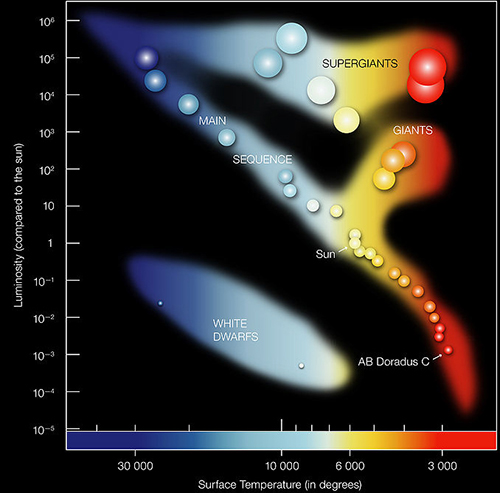
In the early 1900s, Ejnar Hertzsprung and Henry Russell concluded that there is a relationship between a star’s luminosity and its size. The luminosity and size was compiled into a graph which will be discussed in more detail in this learning activity and is depicted in the following diagram. Hertzsprung noticed that stars of the same colour – and thus the same temperature – have a wide variety of magnitudes (and thus luminosities). Why is this?
The Stefan-Boltzmann equation hints at the solution. If you solve for the radius of a star, you get the following equation that relates the star’s radius (R) to its luminosity (L):
If everything but radius and luminosity are stripped away, the key relationship can be found as follows:
Hertzsprung proposed that if the temperatures of two stars are identical (and thus their overall colour and spectral class are identical), then the bigger a star is, the more luminous it will be. He called large, bright stars “giants.”
At about the same time, Henry Russell was coming to similar conclusions while working at Princeton University in the United States. Russell coined the term “dwarf” to refer to the opposite type of star: one that is small and dim compared to other stars of the identical colour or spectral class.
Explore this!

Russell’s brilliant idea in 1914 was to graph his data. On the vertical axis he put the stars’ absolute magnitude (more about magnitudes in a later learning activity), and on the horizontal axis he put the star’s spectral class. The following video animates Russell’s graph.
When he plotted the values for the known stars, Russell observed that most stars lay close to a line he called the main sequence. Over the years, as more precise data were collected, Russell’s original diagram was renamed the Hertzsprung-Russell (H-R) diagram to recognize Hertzsprung’s contribution to its development. With the addition of more stellar data, the modern version of the H-R diagram can be constructed.
The H-R diagram was a major milestone in the understanding of stars. For the first time, it was clear that stars could be categorized into a few groups based on simple and measurable characteristics. Referring to the following Hertzsprung Russell diagram, note the main categories of stars based on the groupings of the data (white dwarfs, main sequence, giants, supergiants). Luminosity is related to absolute magnitude, and temperature is related to colour or spectral class.
A modern Hertzsprung-Russell diagram. Absolute magnitude (related to luminosity) is on the vertical axis and on the horizontal axis is colour of spectral class (here called “colour index”), which is related to temperature.
Main sequence stars
Most stars fall within the zone called the main sequence, which means as stars get hotter, they get brighter. The Earth’s star, the Sun, falls in the middle of the main sequence. Three other types of stars are recognized based on where they fall within the H-R diagram: supergiants, red giants, and white dwarfs.
The following table lists the characteristics of each star type.
| Star type | Description |
|---|---|
| Main sequence | Normal stars like the Sun: 80–90% of all observed stars are in this group, including the small stars called red and brown dwarfs (< 0.5 Msun, with low temperature) |
| Red giant | Large in size but low in temperature |
| Supergiant | Extremely luminous stars that can be either cool or hot |
| White dwarf | Stars with very small radii but very high temperature |
The main sequence contains the vast majority of all stars. These stars are generally powered by the fusion of hydrogen into helium (H–He fusion), although higher-mass stars in the group use a slightly different process called the CNO cycle, which involves carbon, nitrogen, and oxygen in the H–He fusion process. The Sun is classified as a yellow-white star and is powered by the H–He fusion process.
Stars can move from one part of the H-R diagram to another, depending on their age and size.
Try it!

Order the categories based on temperature using the drop-down menu. The highest temperature will be first, and lowest temperature last. Then press Submit to check your understanding.
Try it!
Order the categories based on luminosity using the drop-down menu. The highest luminosity will be first, and lowest luminosity will be last. Then press Submit to check your understanding.
Stars: Birth, life, and death
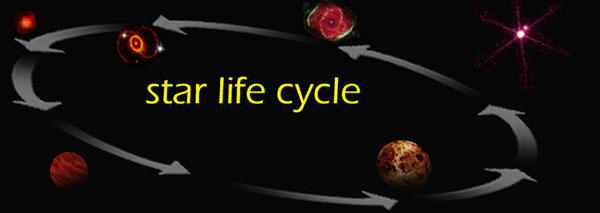
It might seem strange to talk about a hot, glowing ball of plasma as being born, living, and dying. A star is not really alive, but it does go through changes over time. A star has a very distinct beginning, when it undergoes fusion and emits light for the first time, and a somewhat distinct end, when its source of energy is exhausted and it gradually fades to nothing. The life cycle of a star is depicted in the following diagram.
Birth of a star
When the universe began, there were no stars or galaxies, just an immense cloud of gas. Most of that gas still exists today, clumped into galaxies and nebulae. Stars are born out of that gas.
The space between stars is called the interstellar medium (ISM). It consists mostly of hydrogen (H) along with some helium (He). These atoms originated shortly after the Big Bang and have dispersed throughout the universe. Traces of other, heavier elements are also in the ISM. These elements are the scattered remains of stars that have reached the end of their lifespan and exploded, ejecting heavier elements such as carbon, sulphur, and oxygen into the ISM.
The density of the ISM is extremely low. It is estimated that the average density of the entire universe is on the order of one atom per cubic metre. Through a series of random events, however, a region of the ISM can have a slightly higher density of gas and dust. This denser region can pull in other material through its slightly stronger gravitational attraction. These regions of denser gas are called protostellar clouds.
Protostellar clouds
For protostellar gas clouds to develop into stars or planets, gravity needs to pull the cloud together into a super-dense ball at the centre.
When the gas inside the protostellar cloud is moving around very fast, it can resist gravity’s pull because gravity is a weak force over the very large distances that make up clouds. In order for a protostellar gas cloud to turn into a star, two conditions must be met:
- The cloud must be massive enough to pull itself together into a more compact size.
- The gases inside it must be moving slowly enough so gravity can keep it together.
A protostellar gas cloud never starts out exactly spherical, so when gravity pulls one together, not all portions come together perfectly and symmetrically. Some portions move into the centre faster than others, causing the gas cloud to begin to spin as it collapses.
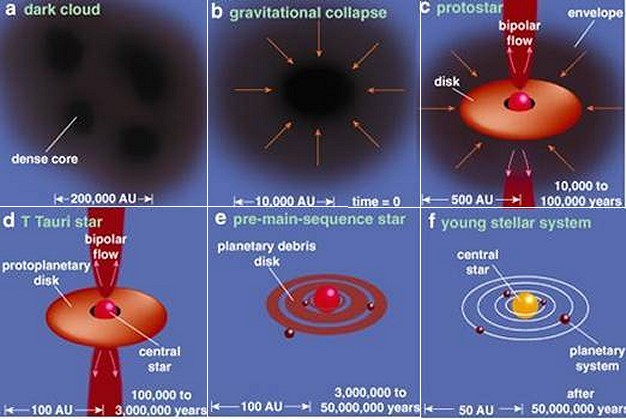
Protostellar cloud. The region of slightly higher density gas in the middle can attract more material through its gravitational pull (straight arrows). It is not perfectly spherical, so the protostellar cloud begins to spin as it contracts (curved arrows).
The faster the sections of protostellar clouds move into the centre, the faster they spin, due to a force that physicists call angular momentum.
As the gas cloud spins faster, it also tends to flatten itself into a disk – think of a pizza-maker spinning a lump of dough. As it spins, the outermost parts stretch even farther away from the centre, and the dough ball gradually flattens out into a two-dimensional pancake. The protostellar disk eventually becomes a flat cloud of gas swirling around a denser inner core.
The denser inner core is called a protostar or a pre-main-sequence star. This is the first stage in the birth of a star. The size produced depends on the size of the protostellar disk – large disks produce large stars, and small disks produce small stars.
Nuclear fusion: A star is born
As the spinning protostellar gas cloud becomes denser, the gas near its core becomes more compressed. The length of time from the initial formation of the protostellar gas cloud to the start of nuclear fusion varies depending on the mass of the cloud.
Large stars form out of large clouds where the force of gravity is stronger so the compression in the core is faster. For example, a large star that is 15 times the mass of the Sun (15 Msun or 15 solar masses) will reach the fusion stage on the order of 104 years. A smaller star will take longer to reach fusion. A small star of mass 0.5 Msun may take 108 years to join the main sequence.
An isolated system heats up if compressed. This naturally happens to protostellar gas clouds.
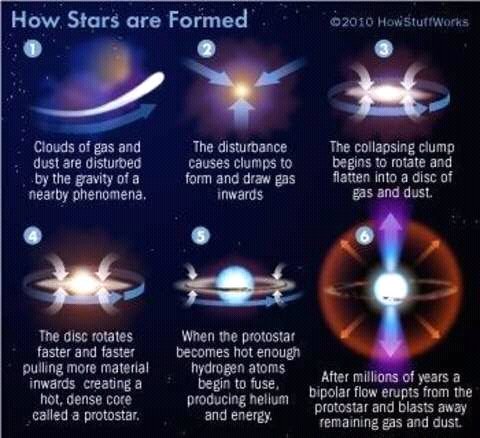
At the centre, the heat is most extreme. The increased heat energy drives off the electrons from the hydrogen atoms, turning the gas into plasma. If the initial gas cloud is large enough, heating continues until the temperature reaches the point where hydrogen-to-helium nuclear fusion is possible. At this point, the star’s light “turns on”, because it now emits visible electromagnetic radiation for the first time. It also starts to push gas away from its core.
Once the star is born and starts to emit light, it eventually joins the main sequence of stars in the Hertzsprung-Russell diagram. The newly formed star starts emitting radiation and the light can actually push any remaining gas and fine dust particles away from the star. The stages of a star forming are outlined in the previous diagram.
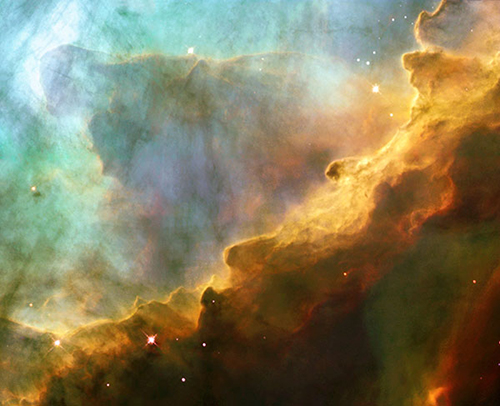
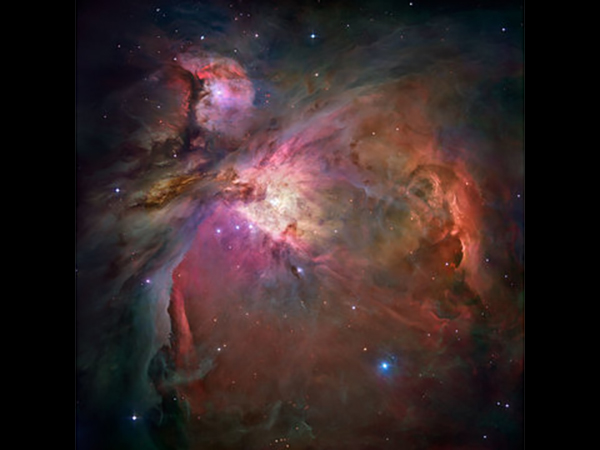
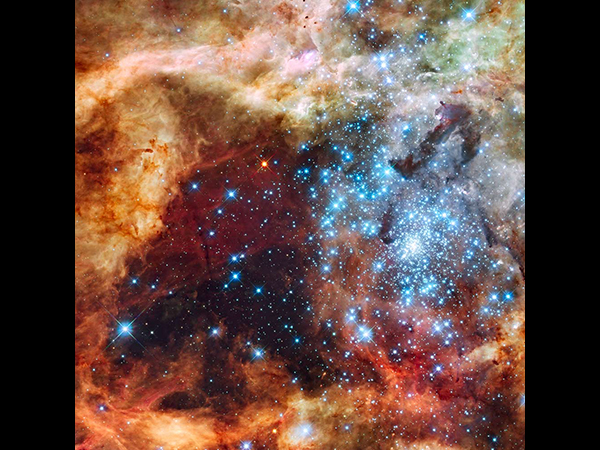
The Omega Nebula
Stars live for a finite time before their fusion fuel source is exhausted or they collapse under their own weight. The lifespan of a star depends on its initial size. Smaller stars spend longer in the main sequence, while larger stars spend less time, because big stars burn out faster.
The Sun, a medium-sized star, should spend about 1010 years in the main sequence. It is about 4.5 × 10⁹ years old now, or a little less than halfway through the main portion of its life. Larger stars such as Spica (10 solar masses) will spend only 107 years on the main sequence, while smaller ones such as Proxima Centauri (less than 0.1 solar masses) could theoretically last 1013 years (much longer than the age of the universe).
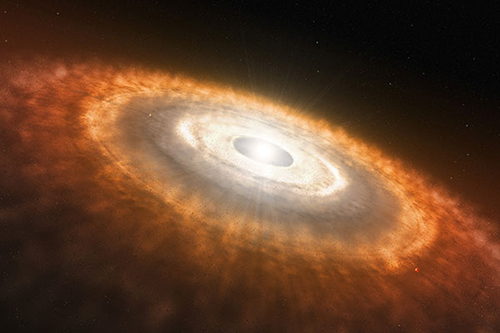
The combined forces of radiation and solar wind sweep out the lighter, less dense elements from the region immediately around the star, forming a gas-free zone.
Later you will learn how this process can lead to the formation of planets and moons like those in the solar system.
Aging of a star
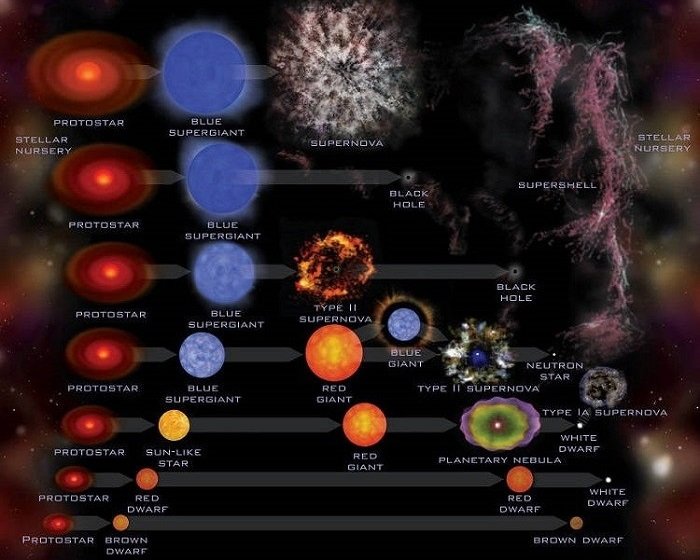
The fate of a star as it ages depends on its initial size. Depending on the size of a star, its internal structure changes in different ways as it ages. The changes that stars of different sizes undergo as they age are depicted in the following diagram.
Press here to open in new window. (Opens in new window)
Low-mass stars (smaller than 0.5 Msun)
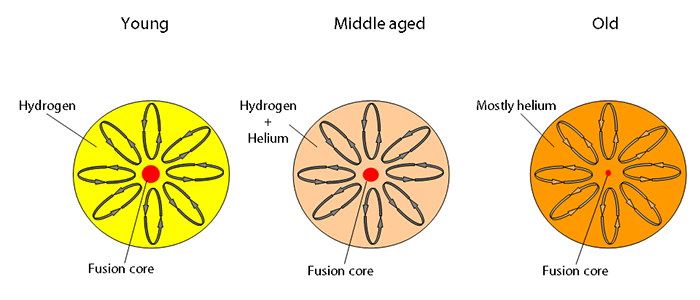
Stars with a mass less than half that of the Sun are called red dwarf stars. They live as long as they as have hydrogen fuel to burn in their fusion reactor. As they are small, the helium produced by the H–He fusion process is carried by convection currents throughout the star. When the star is young, it is made up mostly of hydrogen and the fusion reaction is strong.
As the star ages, more helium spreads throughout, so the concentration of hydrogen to fuel in the fusion reaction declines. When the star is old, most of the hydrogen has been converted to helium and the fusion reaction slows down until it stops. This process could take up to 1013 years and is presented in the following diagram.
Medium-mass stars (0.5 to 1.5 Msun)
Stars with a mass similar to the Sun (0.5 to 1.5 Msun) are large enough that the helium produced in the core can’t dissipate evenly throughout the star by convection. The outer layer remains convective, but the zone around the fusion core becomes conductive.
As a result, the helium made at the core can’t circulate throughout the star. It is stuck around the core, which poisons fusion in the core because new hydrogen can’t be brought in. A shell of H–He fusion develops around the helium core. The shell moves outward as the hydrogen is consumed, leaving a helium core. The following diagram illustrates the process of medium-mass stars as they age.
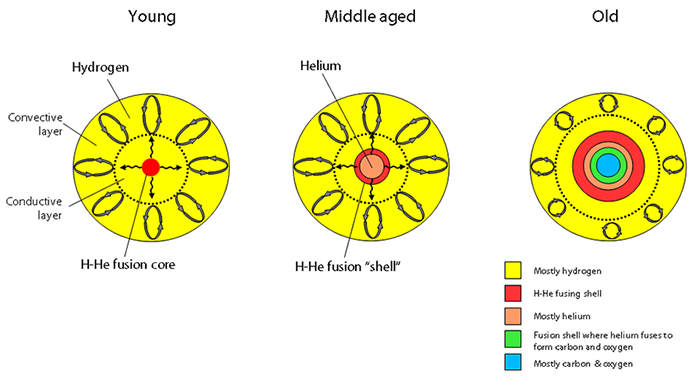
Three ages in the life of a star similar in size to the Sun, which contains a convective outer layer and a conductive centre. The helium can’t quickly leave the core, so it builds up, causing the H-He fusion to occur in a shell around it. The pressure of the built-up helium causes the core to reach such a high temperature that helium itself fuses into higher elements such as carbon and oxygen. The aging star forms into an onion-like layered pattern of elements and fusion that gets bigger as the star gets older.
By the time the star is old, the core temperature gets high enough to allow helium to fuse into higher elements such as carbon, oxygen, and some neon. The star is structured like the layers of an onion.
The extra energy produced by the fusion of heavier elements causes two things to happen:
- The outer layers of the star are pushed farther outwards, making the star larger and therefore more luminous.
- Since the star is larger, the surface cools down and becomes more red.
The Sun is massive enough to fuse elements only up to carbon, neon, and oxygen. Larger stars can produce even heavier elements.
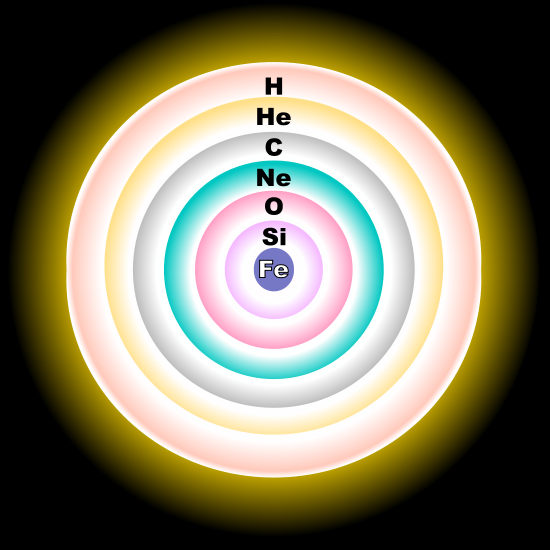
A large star develops concentric circles of fusion reactions, producing heavier elements closer to the centre. Where the pressure and temperature permit, concentric shells of hydrogen (H), helium (He), carbon (C), neon (Ne), oxygen (O), and silicon (Si) plasma are burning inside the star. The resulting fusion by-products fall into the shell below. At the centre of the core is iron (Fe) plasma.
These changes cause the star to move up and to the right on the Hertzsprung-Russell diagram, off the main sequence as observed in the following diagram.
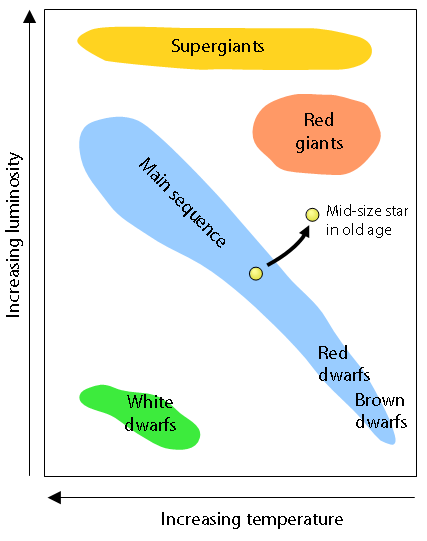
A mid-size medium-mass star, similar to the Sun, moves off the main sequence as it ages.
High-mass stars (larger than 1.5 Msun)
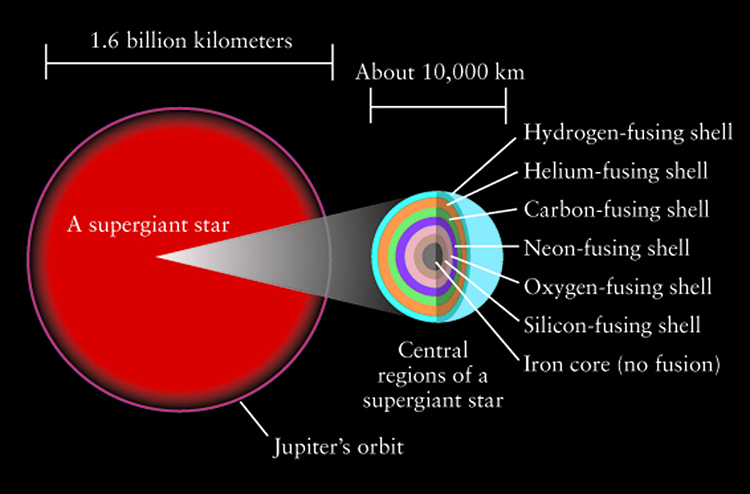
The larger the star, the greater the inward pressure acting on its core. This means the element-fusing process can produce heavier elements. The elements are formed in concentric circles of different fusion reactions, with the heavier ones closer to the core. Larger stars (> 1.5 Msun) can fuse elements up to iron. After that, the nuclear fusion process actually consumes energy rather than producing it. The resulting fusion by-products rain down upon the next lower layer, building up in the shell below. As a result of silicon (Si) fusion, an inert core of Iron (Fe) plasma steadily builds up at the centre. This process is depicted in the following diagram of a supergiant star.
A star will burn as long as it has fuel and a stable structure. Once either of those breaks down, the star begins its death process.
Death of a star
Only the initial mass of a star determines its fate. The following table shows the fate of stars of different size classes relative to the Sun.
| Mass (Msun) | Death process | End product | Size of remnant |
|---|---|---|---|
| < 0.5 (small) | Gradually fades away | Black dwarf (theoretical) | Approximately the size of Earth |
| 0.5–8 (medium to large) | Red giant, planetary nebulae thrown off | White dwarf | Approximately the size of Earth |
| 8–25 (very large) | Red supergiant, then explodes in a supernova | Neutron star | A few kilometres across |
| > 25 (huge) | Red supergiant, then explodes in a supernova | Black hole | Zero? |
Death of small stars
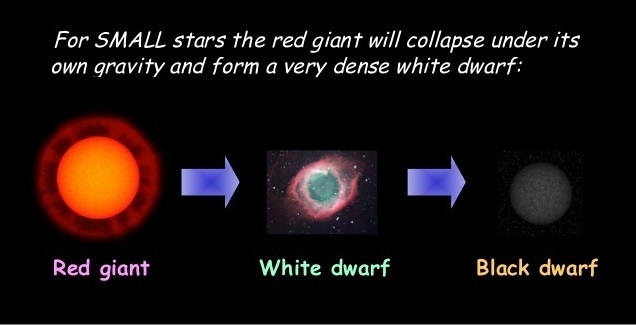
Small stars are < 0.5 Msun. Since they contain only a convection zone, all their hydrogen gets converted to helium without any layering inside the star. As the hydrogen fuel runs out, the star gets dimmer and smaller until it eventually stops burning. The result is a dense cloud of cold gas about the size of the Earth called a black dwarf, which emits no light at all. The stages are evident in the following diagram. Since it takes at least 1013 years for a star to reach black dwarf status, and the universe is far younger than that, it is unlikely that there are any black dwarfs in existence.
Death of medium to large stars
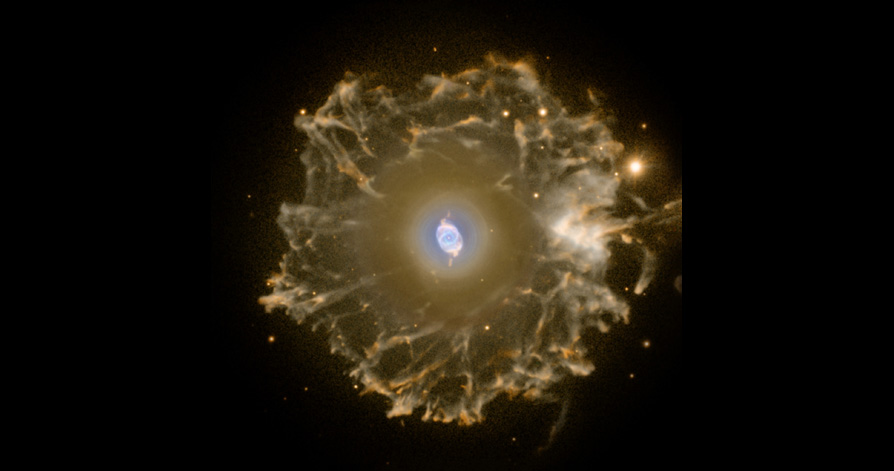
Medium to large-sized stars (0.5 to 8 Msun), such as the Sun, live for about 10 billion years. When one of these stars eventually runs out of hydrogen fuel, it expands to many times its previous size and becomes a red giant. It eventually sheds its outer layers of gas, which become a planetary nebula, while the core cools and contracts into a compact, dense white dwarf. The white dwarf forms because once the fusion reaction stops, the outward pressure caused by the radiation stops, which allows gravity to collapse the material down to an incredibly small and dense (but hot) star. It will eventually cool off to become a black dwarf.
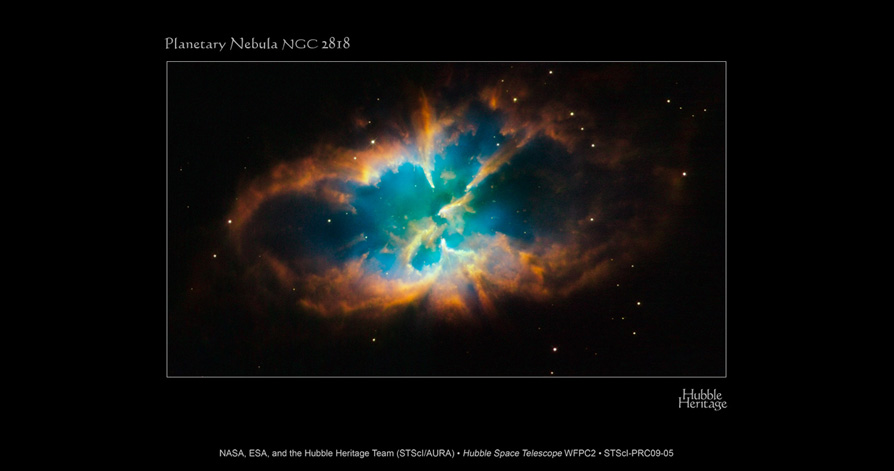
Planetary nebulae are beautiful clouds of gases that get ejected when a star becomes a red giant. The star’s size and power output abruptly change, which causes the ejection. The gases form a cocoon around the remains of the star, now called a white dwarf.
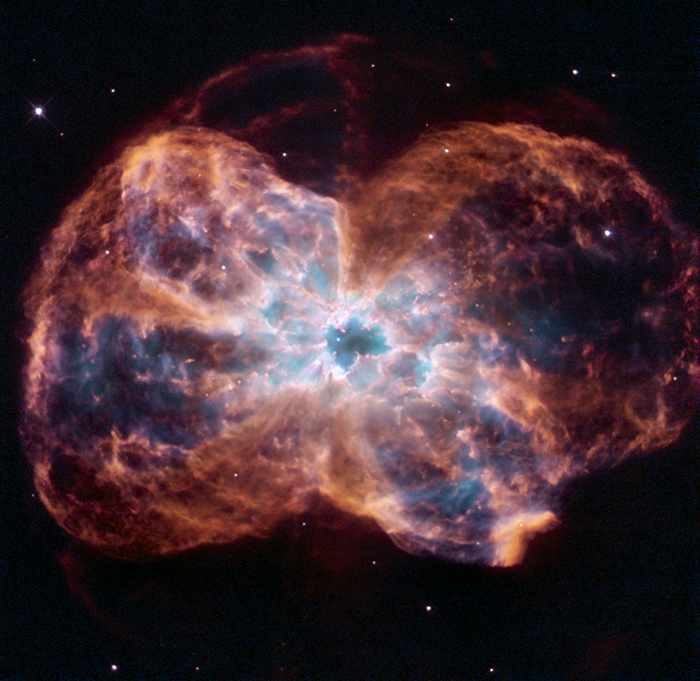
Planetary nebula surrounds a white dwarf star.
The cloud is lit from the inside by the light from the
white dwarf.
Death of very large stars
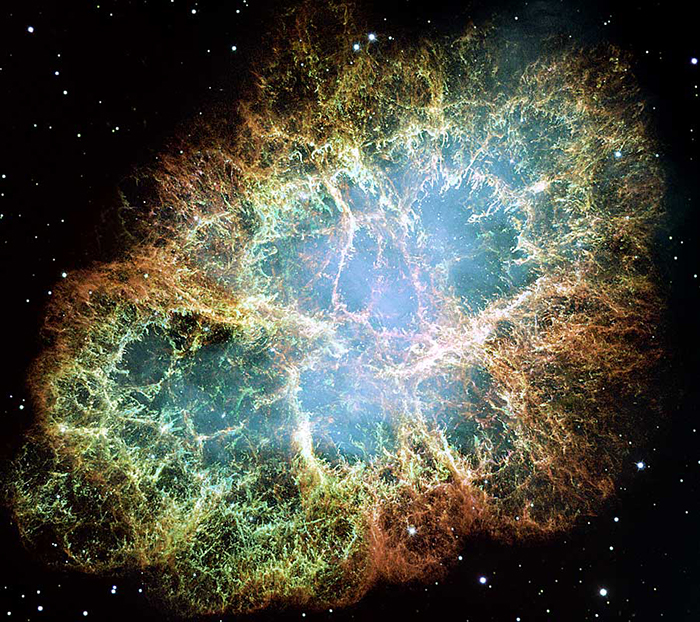
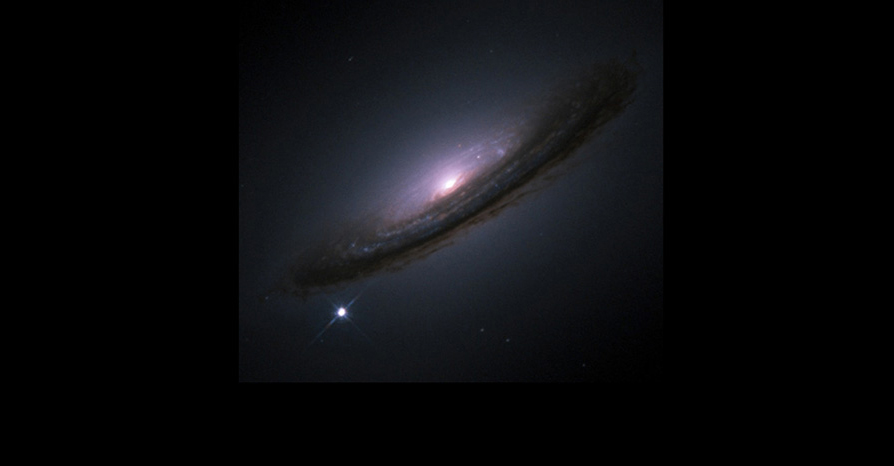
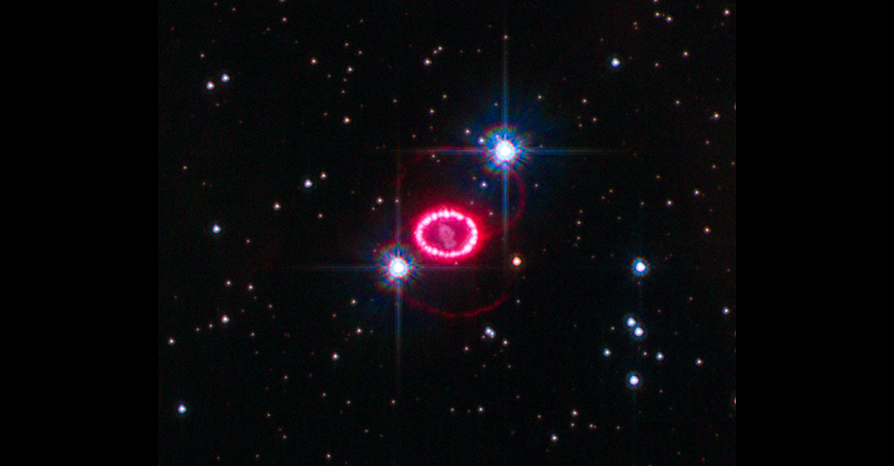
When a very large-mass star (8 to 25 Msun) dies, it undergoes a massive explosion called a supernova. When the fuel runs out and fusion stops, the radiation and convection forces pushing outward from the core also stop. The huge gravitational forces now take over and cause the material to collapse inward toward the dense core. The inner layers collapse first, making the core even denser. By the time the outer layers collapse inward, the core’s density is so incredibly high that the outer layers bounce off the core and ricochet out into space. This creates a bright flash of light and radiation called a supernova, which often illuminates a nebula cloud for several years.
After the explosion, the resulting object is called a neutron star. In it, the protons and electrons have been compressed together to form an ultra-dense collection of neutrons. It is so dense that a teaspoon of it weighs several tons! It glows because it is hot, and it spins extremely rapidly because of its small size.

John Richard Bond
John Richard Bond is a Canadian astrophysicist who specializes in the study of the structure of the Universe.
Dr. Bond’s research of supernova explosions, neutron stars, and neutrinos demonstrated that small variations in the cosmic background radiation reveals details about the shaping of the Universe. As director of research programs at the Canadian Institute for Advanced Research, Dr. Bond studies dark energy and the causes of the rapid expansion of the Universe.
The Crab Nebula
Death of huge stars
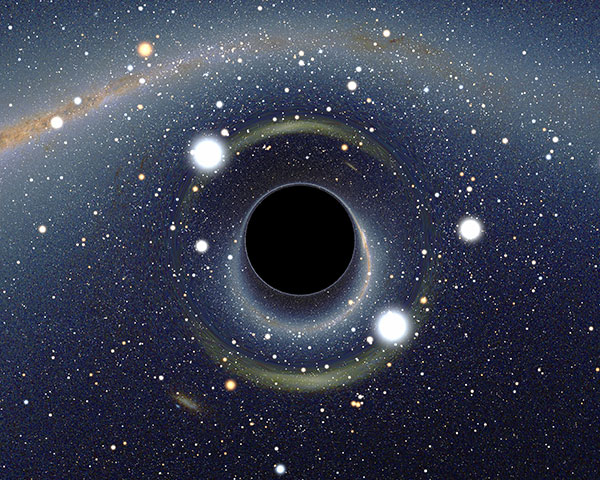
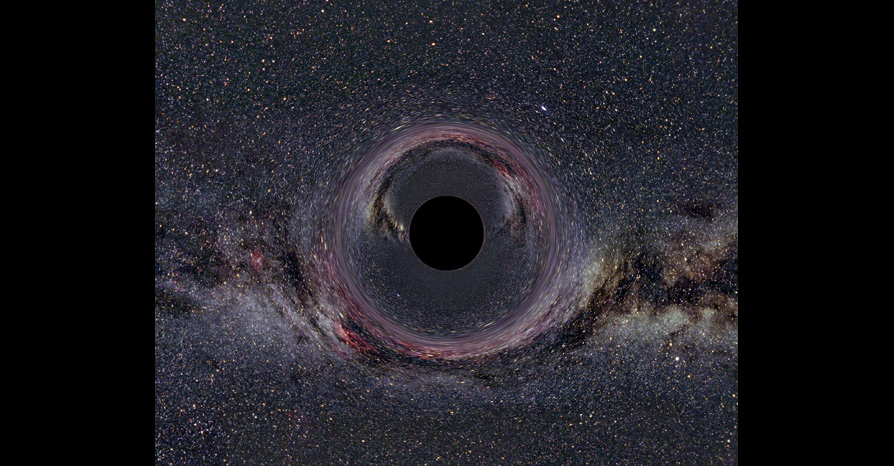
When a huge star (> 25 Msun) dies and becomes a supernova, the energy it gives off is immense. If the level of energy is high enough, a strange object called a black hole may form. The star collapses down to a volume approaching zero, which makes it incredibly dense. Black holes contain so much mass in such a small volume that the strong gravitational field surrounding them allows no radiation to escape it. This means it does not emit any light on its own, and so appears black. It is undetectable using normal methods.
Katie Bouman helped construct the first image of a black hole in 2019 using an algorithm. This algorithm coordinated images from eight different telescopes around the world to form the Event Horizon Telescope to turn the entire Earth into a giant radio telescope.

Katie Bouman
The 5 petabytes of data on hard drives were flown to Katie and her team to analyze the collected data and fill in all of the missing information that would have been collected if she had the Earth sized telescope required to observe M87’s black hole from 55 million light years away!
Black holes
There are two ways to detect black holes indirectly:
- They can accelerate material inward toward themselves, and accelerating charged objects emit radiation. This means that if a mysterious source of high-energy radiation, such as X-rays, appears to be coming from nowhere, it might actually be coming from a black hole. This is how the first black hole candidate, Cygnus X-1, was discovered in the early 1970s.
- Their mass can bend light, so they act like a gravitational lens to distort images of stars and galaxies behind them.
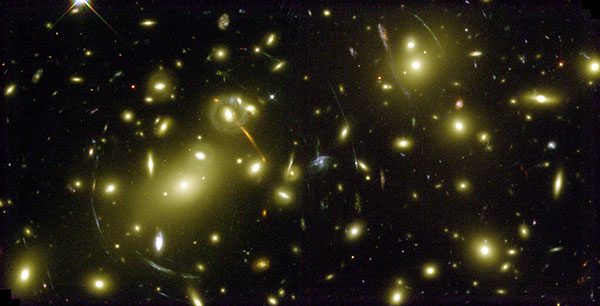
Images of distant galaxies behind Abell 2218 are distorted by its gravity and so appear as streaks or smears.
If massive energy events occur, Albert Einstein predicted in his special theory of relativity in 1916 that gravitational waves would form as ripples in spacetime. The Laser Interferometer Gravitational-Wave Observatory (LIGO) operated by CalTech and MIT made the first direct observations of a spacetime wobble in 2015 – 100 years after Einstein’s prediction and 1.3 billion light years after the 2 black holes collided! This was an incredible scientific achievement because even though the original event would have been extremely violent, by the time the gravitational wave reached earth, the space time wobble was one thousand times smaller than the nucleus of an atom.

Review

Review the following for a summary of star formations.
Review of star birth
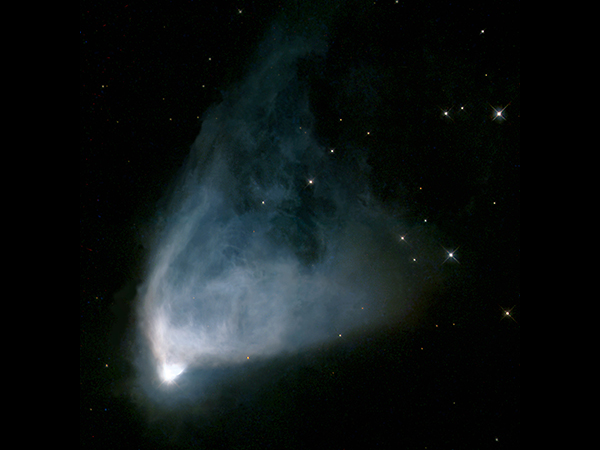
Review of dying stars
Review
Review the following for a summary of dying stars.
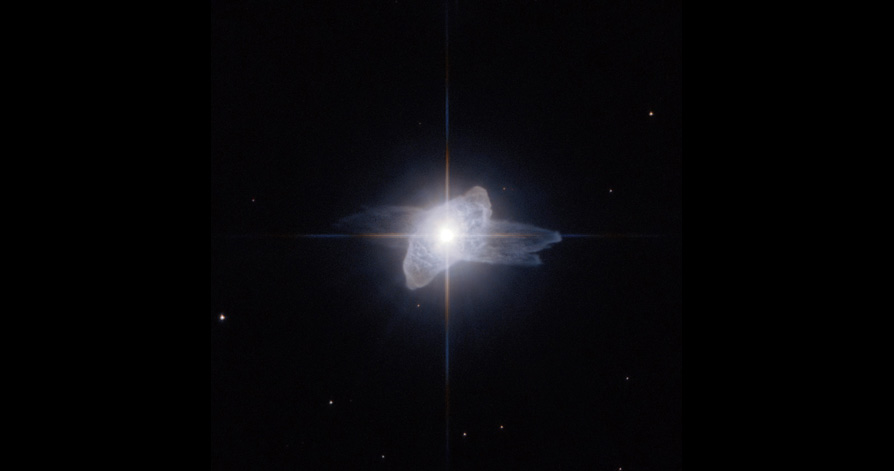
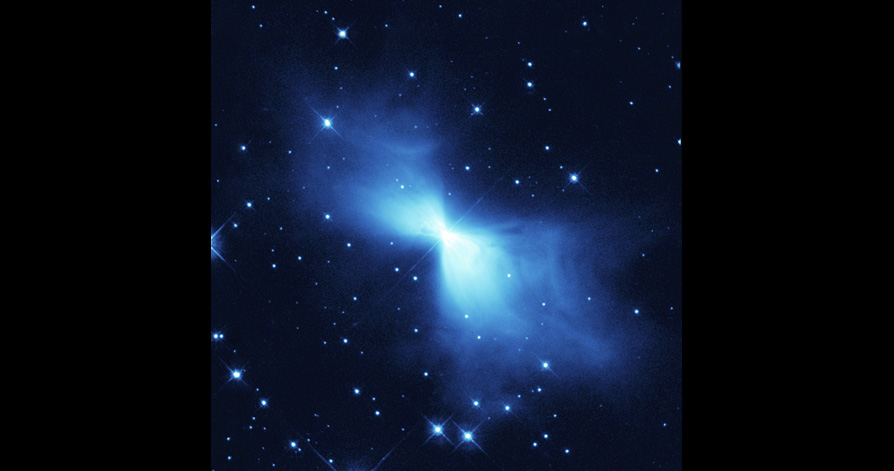
Review of the death of stars
Review
Review the following for a summary of the death of stars.
Quiz

It is time to show what you have learned by taking this quiz about content covered in this learning activity. Prior to starting the quiz, review all material and ensure you are ready to begin. Good luck!
Conclusion
In this learning activity, you increased your knowledge of stars: how they are formed, why they give off light, and what happens when they die. In the next learning activity, you will consider how astronomers make accurate measurements and calculations of distance, brightness, and location of stars and galaxies.